

You’re running a screen printing shop because you love the craft. There’s something incredibly satisfying about seeing a fresh design hit a high-quality garment and knowing your customers are going to wear it with pride. But we know the reality behind the scenes: the ink-stained hands, the late nights at the dryer, and that nagging feeling that despite being busy, the bank account isn't growing the way it should.
If you feel like you’re "printing money" but never actually seeing it, the culprit is almost always job costing.
For screen printing businesses, job costing is the difference between a thriving shop and one that is just spinning its wheels. It’s the process of tracking every single penny that goes into a specific order: from the garment and the ink to the electricity running the flash dryer and the time spent reclaiming screens.
At Equilibrium Consultants, we specialize in bookkeeping for screen printers, and we’ve seen where the leaks happen. Here are the 10 most common reasons your job costing isn't working and, more importantly, how we can help you fix them.
1. You’re Underestimating the "Setup Squeeze"
Each additional ink color isn't just a different bucket of goop; it’s a setup cost. Between burning the screen, taping it off, aligning it on the press, and the inevitable test prints, each color can add $20–$40 in setup costs alone. Many shops roll this into a flat fee that hasn't been updated since 2019.
The Fix: Calculate your actual "time-to-press" for each screen. If your setup takes 20 minutes per color and your shop rate is $60/hour, that’s $20 of labor before a single shirt is printed.
2. The "Dark Garment" Ink Trap
Printing on a black hoodie isn't the same as printing on a white tee. On dark garments, you almost always need an underbase: a layer of white ink that makes the other colors pop. This can increase your ink usage by up to 20%. If you aren't accounting for that extra pass and extra ink, you’re eating the cost.
The Fix: Use a tiered pricing model that accounts for underbases. When we handle job costing for screen printing businesses, we help you build these variables directly into your estimates.
3. Ignoring the "Unbilled" Labor
Labor isn't just the time spent pulling a squeegee. It’s the time spent counting in the boxes when they arrive from the wholesaler, the time spent cleaning the ink off the spatulas, and the time spent talking to the client about why their low-res JPEG won't work.
The Fix: Perform a "Time Study." For one week, track every minute spent on a job from start to finish. You’ll likely find that 30% of your labor is currently "invisible" to your pricing.

4. Failing to Allocate Fixed Overhead
Your rent, insurance, and that expensive direct-to-screen (DTS) lease stay the same whether you print 100 shirts or 10,000. If you don't know your "overhead per hour," you can't accurately price a job. Many shops try to guess, but guessing leads to "ghost losses" at the end of the month.
The Fix: Divide your total monthly fixed costs by your total production hours. That is your baseline. Every hour the press is running must cover that amount before you even think about profit.
5. The Multi-Location Profit Killer
A shirt with a front chest print, a back print, and a sleeve hit is essentially three separate jobs bundled into one. However, shops often give deep discounts for multiple locations without realizing that each location requires its own setup, screen, and specialized pallet.
The Fix: Treat every print location as a unique setup event. Ensure your bookkeeping for screen printers tracks the profitability of multi-location jobs specifically: you might find they are actually your least profitable orders.
6. The "Art Department" Time Sink
We’ve all been there: a client sends an image they pulled off a Google search that is 72 DPI and the size of a postage stamp. Your artist spends two hours rebuilding it into a vector file, and you don't charge for it because "it’s just part of the service." That just cost you $60–$100 in unbilled labor.
The Fix: Enforce a strict artwork policy. Require vector formats (.AI, .EPS, .SVG) and have a flat "Art Preparation Fee" for anything else. It protects your artist's time and your bottom line.
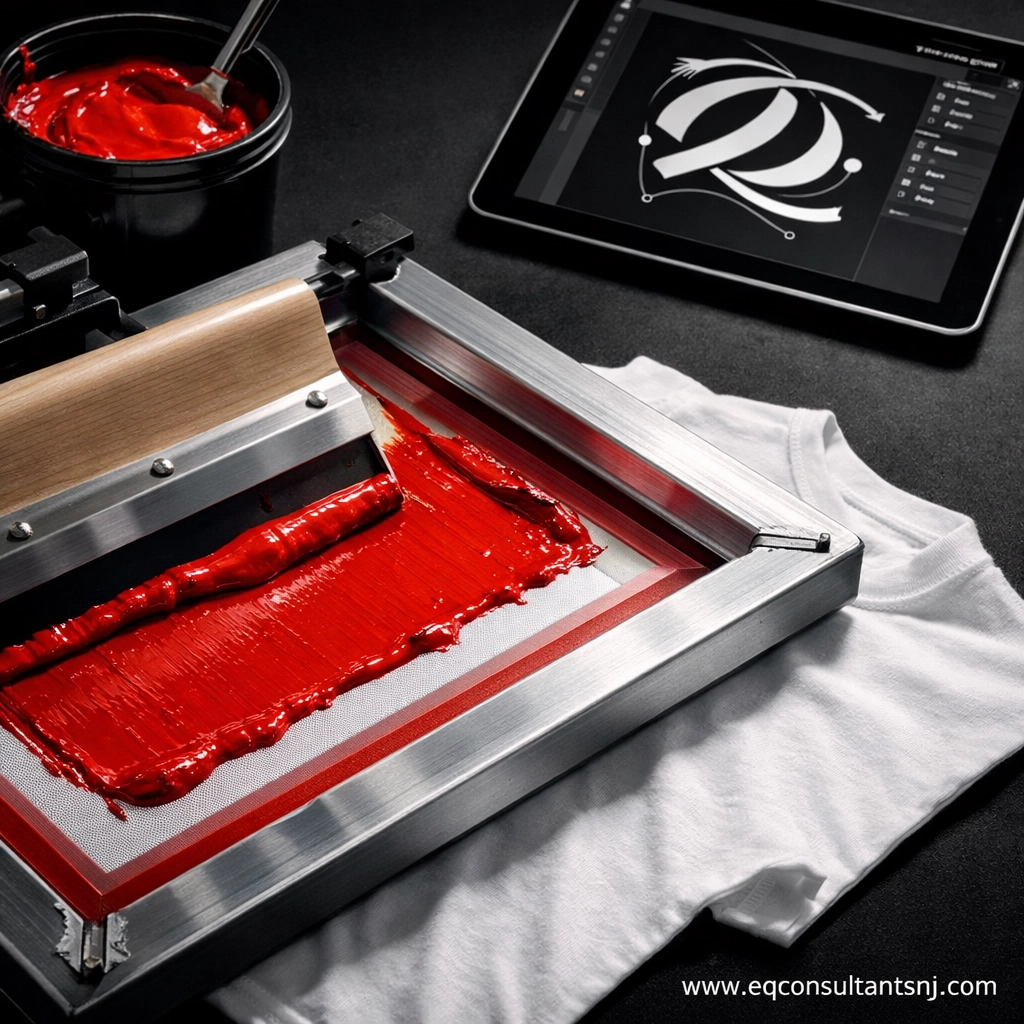
Visualizing the workflow: From raw art to finished print, every step has a cost.
7. The Small-Batch "Favor"
Small orders (under 24 pieces) are the hardest to make money on because the setup time is the same as a 500-piece order, but the volume doesn't absorb the cost. If you aren't charging a premium for these, you are essentially paying the customer to print their shirts.
The Fix: Set a Minimum Order Quantity (MOQ) or implement a "Small Run Surcharge." Be firm. Your time is valuable, and small batches should reflect that.
8. Chemical and Supply Waste
Aerosol adhesives, screen degreasers, and emulsion are often treated as "free" supplies. But if your team is over-applying adhesive or using the wrong mesh count (wasting ink), those costs add up over thousands of prints.
The Fix: Audit your supply consumption. Dilute chemicals according to manufacturer specs and train your team on proper ink management. Small savings on every shirt lead to big gains at year-end.
9. Inefficient Production Scheduling
If you print a red job, then a white job, then another red job, you’ve wasted time cleaning the press twice. Poor scheduling is a hidden cost that destroys your "capacity": the total amount of work you can actually get done in a day.
The Fix: Batch your jobs by ink color or garment type. This reduces changeover time and allows your team to stay in a "flow state," increasing the number of shirts per hour (SPH) you can produce.
10. The Lack of Real-Time Financial Visibility
The biggest reason job costing fails is that it's done in a vacuum. You might think a job was profitable, but if your bookkeeping isn't synced with your production, you won't know for sure until your tax return is filed: and by then, it's too late to change anything.
The Fix: You need a financial system that talks to your production reality. If your current books are a mess, we offer catchup and cleanup services to get your history organized so you can look forward with clarity.
You’re in Safe Hands
We don't just fix : we improve. Understanding the nuances of screen printing is what sets us apart from a generic bookkeeper. We know what a "flash" is and why "reclaiming" matters. We help you turn those technical details into a solid financial strategy.
If you’re tired of wondering where the profit went at the end of a long production run, let's get your systems in order. Whether you need a Fractional CFO to help with high-level strategy or a dedicated partner for bookkeeping for screen printers, we are here to support your growth.

At Equilibrium Consultants, we love working with inspiring clients who are passionate about their craft. Your screen printing business is a labor of love, and we want to help you make sure it’s also a powerhouse of profit. We’d love to learn more about your shop and your goals for this year.
Ready to see the real numbers behind your business?